
Poulenc Flute Sonata: A Comprehensive Guide
Exploring the Poulenc Flute Sonata necessitates access to reliable scores; numerous editions, including readily available PDF versions, cater to flutists and pianists alike.

Understanding the Context of the Sonata
Delving into the Poulenc Flute Sonata requires appreciating its place within the broader landscape of 20th-century French music, and locating suitable scores is paramount. Fortunately, numerous editions of the sonata exist, catering to diverse performer preferences and budgets. Many flutists and pianists now utilize readily accessible PDF versions for practice and performance, offering convenience and portability.
Understanding Poulenc’s compositional style – a blend of wit, charm, and occasional melancholy – is crucial for interpreting the sonata’s nuances. His connection to “Les Six,” a group of French composers, shaped his aesthetic, moving away from the grandiose Romanticism of the previous era. The sonata itself reflects this stylistic fingerprint, showcasing a unique harmonic language and melodic sensibility. Accessing a clean, well-edited PDF score allows musicians to focus on these interpretive details, rather than grappling with inaccurate or poorly presented notation.
I. Francis Poulenc: A Biographical Overview
Poulenc, a French composer and pianist, created diverse works, including the Flute Sonata; accessing scores, often in PDF format, aids study.
A. Early Life and Musical Influences (1899-1920s)

Born in 1899 into a wealthy Parisian family, Francis Poulenc’s early musical development wasn’t formally structured, yet profoundly shaped his distinctive style. While not initially steered towards rigorous classical training, he began piano lessons and demonstrated an aptitude for composition. Influences during this period included composers like César Franck and Richard Viñes, alongside exposure to popular song and the vibrant artistic milieu of 1920s Paris.
This formative era saw Poulenc gravitate towards a blend of sophistication and accessibility, characteristics later evident in works like the Flute Sonata. The availability of scores, including convenient PDF versions, allows modern musicians to trace these early influences within his compositional choices. His family background afforded him freedom to explore diverse musical avenues, fostering a unique voice that defied strict categorization, a quality readily apparent when studying the Flute Sonata’s score.
B. Poulenc and “Les Six”
Francis Poulenc was a pivotal member of “Les Six,” a group of French composers who rejected the grandiose Romanticism of composers like Wagner, favoring instead clarity, wit, and a return to classical forms. Alongside composers like Darius Milhaud and Arthur Honegger, Poulenc sought a distinctly French aesthetic, embracing popular music and everyday life as inspiration. This collaborative spirit fostered a unique compositional approach, influencing his stylistic choices.
While the Flute Sonata doesn’t explicitly showcase the collective style of “Les Six,” its inherent charm and melodic directness reflect the group’s broader aesthetic. Accessing the score, often available as a convenient PDF, reveals how Poulenc balanced classical structure with a playful, modern sensibility. Studying the work alongside pieces by his contemporaries illuminates the shared artistic values of this influential group and their impact on 20th-century music.
C. Key Characteristics of Poulenc’s Compositional Style
Poulenc’s compositional voice is marked by a delightful duality – a blend of sophisticated harmonic language and a seemingly effortless melodic grace. He masterfully juxtaposes moments of poignant lyricism with playful irony and unexpected shifts in mood. His music often features a deceptive simplicity, concealing intricate craftsmanship and a keen understanding of musical form. This stylistic fingerprint is readily apparent when examining the Flute Sonata.
A detailed score, easily found as a PDF, showcases Poulenc’s penchant for seductive instrumentation and harmonic nonchalance. The work exemplifies his ability to evoke a range of emotions, from melancholy to exuberance, often within a single phrase. Studying the PDF allows performers to appreciate the nuances of his writing and capture the unique blend of wit, charm, and emotional depth that defines Poulenc’s enduring appeal.
II. The Flute Sonata: Historical Background
Accessing the Poulenc Flute Sonata’s history is aided by readily available PDF scores, revealing its 1957 composition and subsequent impact on flute repertoire.
A. Composition Date and Circumstances
The Poulenc Flute Sonata, a cornerstone of the flute repertoire, emerged in 1957, commissioned by Elizabeth Sprague Coolidge, a prominent patron of the arts. This commission provided Poulenc with the impetus to create a work for an instrument he hadn’t previously explored extensively. Interestingly, despite his established reputation, Poulenc initially felt somewhat hesitant about composing for the flute, viewing it as potentially limited in expressive capacity.
However, the commission spurred him to overcome these reservations, resulting in a sonata that beautifully showcases the instrument’s lyrical and virtuosic possibilities. The availability of modern, high-quality PDF scores allows performers today to study the work’s intricacies with ease. The compositional process occurred during a period of relative stability in Poulenc’s life, allowing for focused creative output. He was already a celebrated composer, and this sonata further solidified his position within the French musical landscape.
B. Premiere and Initial Reception
The premiere of the Poulenc Flute Sonata took place on December 14, 1957, at the Library of Congress in Washington D.C., performed by the esteemed flutist Rampal, alongside pianist Pascal Devoyon. The initial reception was overwhelmingly positive, with critics praising its melodic charm, harmonic sophistication, and effective writing for both instruments. Many noted the surprising freshness and vitality of the work, defying Poulenc’s earlier self-doubt about the flute’s capabilities.
Contemporary reviews highlighted the sonata’s blend of wit, lyricism, and underlying melancholy, characteristics often associated with Poulenc’s compositional style. Today, readily accessible PDF versions of the score have facilitated widespread performance and study. The sonata quickly entered the standard repertoire, becoming a favorite among flutists and audiences alike, cementing its place as a significant contribution to 20th-century chamber music.
C. Place within Poulenc’s Larger Oeuvre
The Flute Sonata occupies a unique position within Francis Poulenc’s extensive and diverse output. Composed relatively late in his career, it showcases a refined maturity while retaining the characteristic Poulencian blend of elegance, wit, and poignant lyricism. Though known for vocal music, operas, and piano works, Poulenc’s instrumental writing demonstrates a remarkable sensitivity to timbre and texture.
The sonata reflects his continued exploration of neoclassical forms, tempered by a distinctly French melodic sensibility. Access to PDF scores allows modern musicians to appreciate its stylistic nuances alongside his other compositions. It stands as a testament to his versatility, proving his mastery extended beyond his most celebrated genres. The Flute Sonata, therefore, isn’t an outlier, but a compelling synthesis of Poulenc’s established artistic voice.
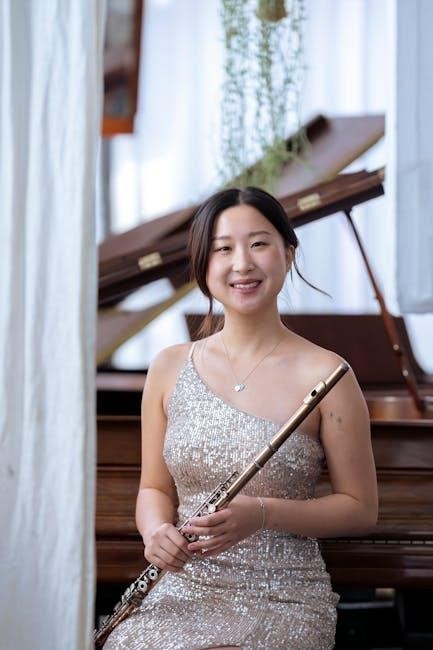
III. Musical Analysis of the Flute Sonata
Detailed analysis, often facilitated by readily available PDF scores, reveals Poulenc’s harmonic language—a captivating blend of tonality, dissonance, and melodic charm.
A. I. Allegro malinconico: Form and Harmonic Language
The opening Allegro malinconico presents a fascinating study in contrasts, expertly utilizing a modified sonata form. Access to a clear PDF score is invaluable for tracing Poulenc’s harmonic shifts, which oscillate between moments of lyrical beauty and poignant melancholy. He masterfully employs chromaticism and unexpected modulations, creating a sense of wistful longing.
The movement’s harmonic language isn’t rigidly tonal; rather, it embraces a sophisticated ambiguity, hinting at tonality without fully resolving. This creates a uniquely Poulencian atmosphere – simultaneously elegant and unsettling. Studying the score, particularly through a digital PDF format, allows for detailed examination of his chord voicings and subtle harmonic devices. The interplay between flute and piano is crucial, with the piano often providing a subtly dissonant harmonic backdrop to the flute’s expressive melodic lines. The form, while recognizable, is subtly disrupted, mirroring the movement’s overall emotional complexity.
B. II. Allegretto: Character and Melodic Development
The second movement, Allegretto, offers a delightful contrast to the introspective Allegro malinconico. A readily available PDF score reveals Poulenc’s playful approach to melodic development, characterized by a charming simplicity and subtle irony. The movement’s character is light and airy, though tinged with a gentle nostalgia. Melodic ideas are often fragmented and playfully transformed, passed between the flute and piano in a delightful conversational manner.
Harmonically, the Allegretto is more straightforward than the first movement, but still retains Poulenc’s signature harmonic wit. Examining the PDF allows for close observation of his use of parallel chords and unexpected harmonic turns. The melodic development isn’t about grand transformations, but rather about subtle variations and playful embellishments. It’s a movement that demands a delicate touch and a keen sense of stylistic nuance, best understood through detailed score study.
C. III; Finale: Pasodoble – Style and Virtuosity
The final movement, a vibrant Pasodoble, explodes with energy and showcases Poulenc’s flair for dramatic effect. A detailed PDF score unveils the intricate interplay between flute and piano, demanding considerable virtuosity from both performers. This movement is a deliberate stylistic departure, embracing a Spanish dance form with Poulenc’s characteristic wit and sophistication. The rhythmic drive is relentless, and the melodic lines are often angular and punctuated.
Analyzing the PDF reveals Poulenc’s masterful orchestration for these two instruments, creating a sound world that is both brilliant and engaging. The Pasodoble isn’t merely a display of technical prowess; it’s a celebration of life and a playful nod to musical tradition. Performers must capture the movement’s inherent theatricality and rhythmic precision, bringing Poulenc’s vibrant vision to life.
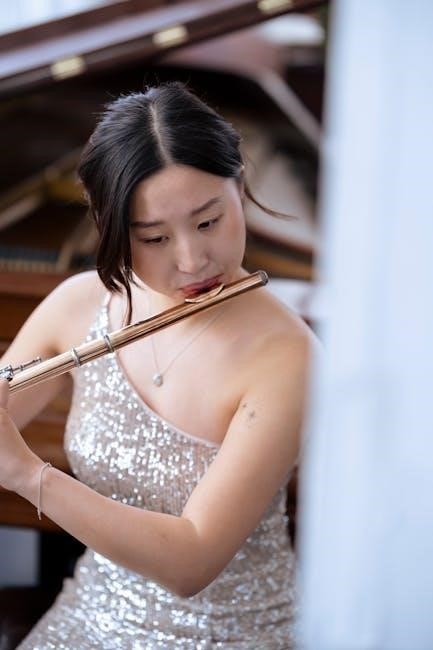
IV. Performing the Poulenc Flute Sonata
Successfully interpreting this sonata requires careful study of a quality score, often found as a convenient PDF, to grasp Poulenc’s nuanced intentions.
A. Technical Challenges for the Flutist
The Poulenc Flute Sonata presents a unique set of technical hurdles for the performer, demanding both lyrical sensitivity and virtuosic flair. Accessing a clear, well-edited PDF score is paramount for navigating these complexities. The Allegro malinconico requires precise articulation and breath control to convey its melancholic character, while maintaining a fluid legato.
The Allegretto, though seemingly lighter, demands nimble fingerwork and a refined sense of phrasing. However, the Pasodoble finale is where the true technical challenges reside; it necessitates exceptional agility, secure high register playing, and a robust tone production. Mastering the rapid passages and wide leaps requires diligent practice and a thorough understanding of the score’s markings. Furthermore, the sonata’s frequent dynamic shifts and subtle rhythmic nuances demand a highly responsive and adaptable technique.
B. Accompaniment Considerations for the Pianist
The pianist’s role in the Poulenc Flute Sonata is far from merely supportive; it’s a crucial partnership demanding equal musicality and sensitivity. A readily available PDF score allows for detailed collaborative study. Poulenc’s writing for the piano is often deceptively complex, featuring intricate harmonies and rhythmic interplay. The pianist must possess a strong sense of independence and the ability to balance the texture, avoiding overpowering the flute while maintaining a vibrant presence.
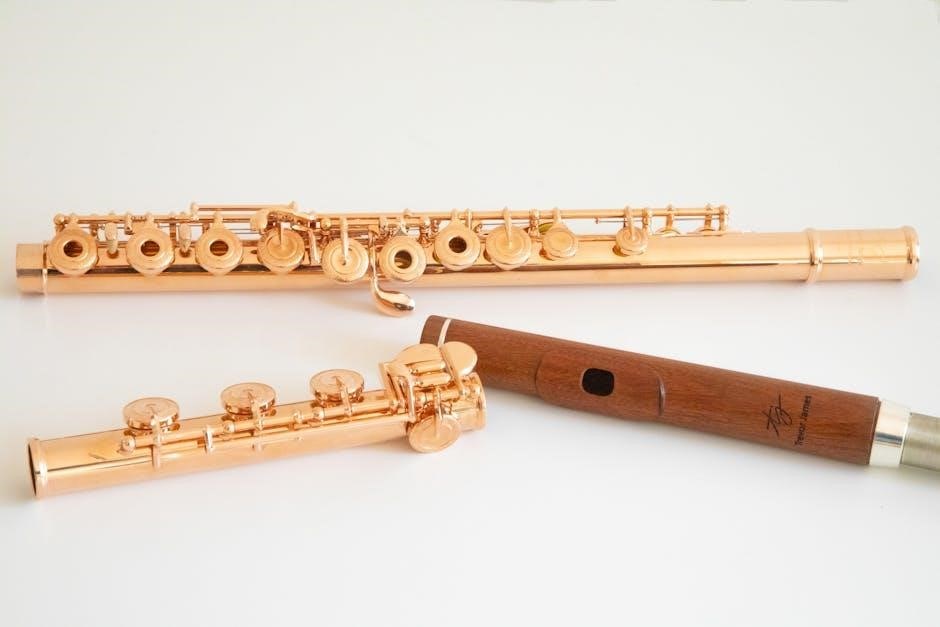
Careful attention to voicing and pedaling is essential to create the desired atmosphere, ranging from the melancholic introspection of the first movement to the spirited energy of the finale. The pianist must also be adept at navigating Poulenc’s characteristic harmonic shifts and subtle rhythmic displacements, responding with flexibility and nuance.
C. Interpretive Approaches and Stylistic Nuances
Interpreting the Poulenc Flute Sonata requires embracing its inherent duality – a blend of wit, elegance, and underlying melancholy. Access to a detailed PDF score aids in understanding these subtleties. Poulenc’s music often oscillates between intimacy and irony, demanding a nuanced approach to phrasing and dynamics. Performers should avoid excessive sentimentality, instead focusing on clarity of line and rhythmic precision.
Stylistically, a degree of French sophistication is paramount. This involves a subtle rubato, a refined sense of touch, and an awareness of Poulenc’s penchant for unexpected harmonic twists. The Pasodoble finale, in particular, calls for a playful yet virtuosic execution, capturing its spirited character without sacrificing musicality.

V. Resources for Poulenc Flute Sonata
Numerous online platforms offer the Poulenc Flute Sonata in PDF format, providing convenient access for study and performance preparation for musicians.
A. Available Editions and Urtext Sources (PDF availability)
Locating a reliable edition of the Poulenc Flute Sonata is crucial for accurate interpretation and performance. Several publishers offer scores, with varying degrees of editorial intervention. For purists seeking an urtext edition – one representing the composer’s original intent with minimal alterations – editions from Durand are highly recommended.
Fortunately, digital access has broadened considerably; many musicians now utilize PDF versions of the score for convenience and portability. Websites specializing in sheet music, such as Musicnotes.com and IMSLP (International Music Score Library Project), frequently host downloadable PDFs, some available legally in the public domain. However, verifying the source’s legitimacy is paramount to ensure accuracy and avoid copyright infringement.
When selecting a PDF, carefully examine the engraving quality and page layout. A clear, well-formatted score will significantly aid rehearsal and performance. Consider comparing different editions to identify any discrepancies in fingerings, dynamics, or phrasing suggestions. Ultimately, the ideal edition will facilitate a nuanced and informed musical experience.
B. Notable Recordings and Performers
Immersing oneself in recordings by esteemed flutists provides invaluable insight into the Poulenc Flute Sonata’s interpretive possibilities. While a PDF score offers the notes, listening to masterful performances reveals the music’s inherent character and stylistic nuances.
James Galway’s recording, often praised for its technical brilliance and lyrical phrasing, remains a benchmark. Emmanuel Pahud offers a more refined and subtly expressive interpretation, showcasing the sonata’s delicate beauty. Other notable recordings feature flutists like Peter-Lukas Graf and William Bennett, each bringing a unique perspective to Poulenc’s work.
Beyond individual performers, exploring recordings with different piano accompanists is equally beneficial. The interplay between flute and piano is vital, and a sensitive partner can elevate the entire performance. Studying these recordings alongside the score (whether in print or PDF format) fosters a deeper understanding of Poulenc’s compositional intent.
C. Scholarly Articles and Analyses
Delving into scholarly resources enhances comprehension of the Poulenc Flute Sonata beyond simply reading a PDF score. Academic articles dissect the sonata’s harmonic language, formal structures, and stylistic influences, providing a deeper analytical framework.
Research often highlights Poulenc’s unique blend of wit, charm, and neo-classical tendencies, contrasting his approach with Romantic predecessors like Chopin. Analyses explore the pasodoble finale’s origins and its playful subversion of traditional forms. Examining these studies alongside the musical text (available as a PDF) illuminates Poulenc’s compositional choices.
Journals dedicated to musicology and flute performance frequently feature articles on 20th-century French repertoire. These resources offer valuable insights for performers and scholars seeking a nuanced understanding of the sonata’s artistic and historical context, enriching interpretation beyond the notes on the page.